


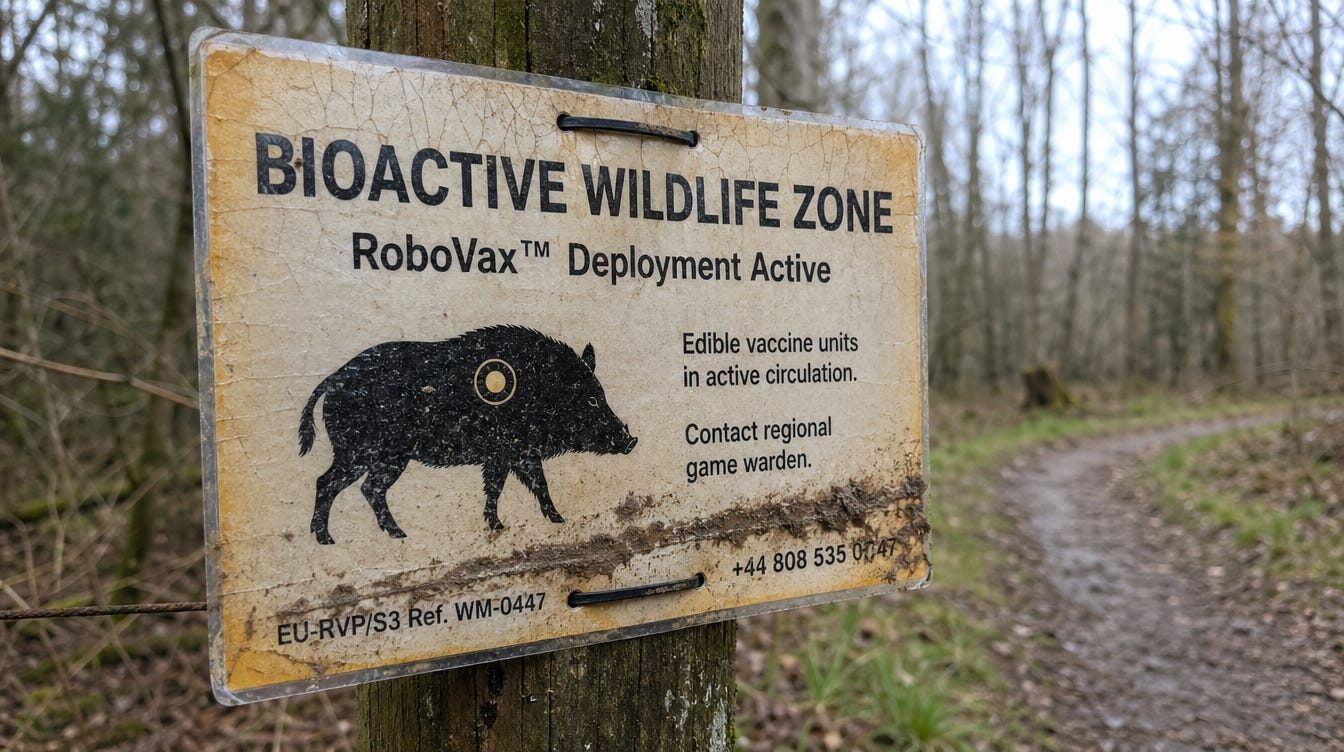
The Janky Time Machine’s probability differential bleed has been acting up. It keeps landing me at the edges of things. Boundaries. Perimeters. Places where one set of rules ends and another begins. Today it deposited me at a forest trail entrance somewhere in continental Europe, on a grey Tuesday morning that smelled like pine resin and damp paperwork.
The signs have gotten more specific. Not “wildlife area” or “nature reserve” — something more operational than that. The forest ahead is active. Something is in there doing a job, and the signage is making sure you know the terms and conditions before you proceed1.
This is a world where vaccination doesn’t happen at a clinic or a school gymnasium. It happens at scale, in the dark, in terrain no syringe could reach. The delivery mechanism wiggles. It is digested. It is, per the certification paperwork, completely safe for consumption by any animal, including the ones you were planning to eat.
Which is why, tucked into hunting license renewal envelopes across the region, there’s a folded advisory slip drafted by someone who really needed you to understand that this is fine.
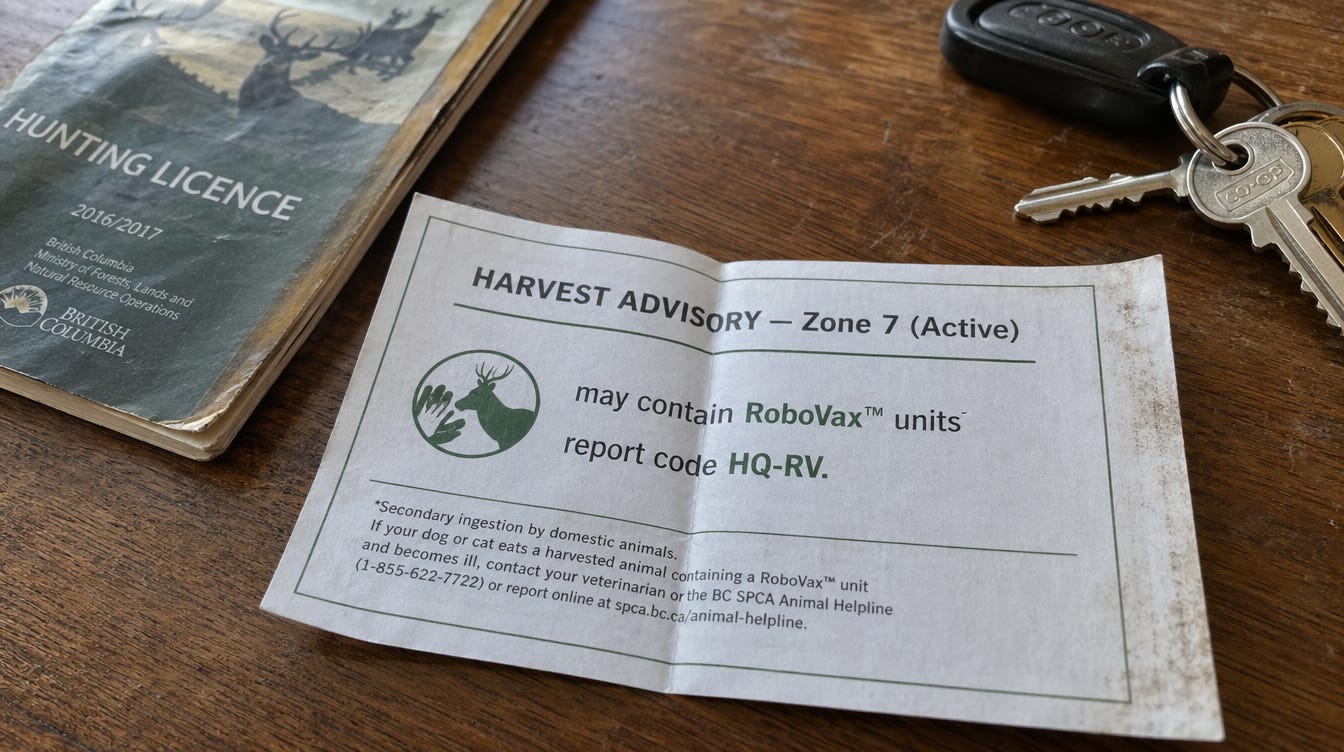
“Units are non-toxic” is doing a lot of lifting in that sentence. The slip doesn’t say the boar you shot last Thursday was full of tiny wiggling robots when you found it. It doesn’t have to. What it says is: if you find one intact, don’t throw it away. Report code HQ-RV. There’s a number.
Someone had to write that guidance. Someone had to decide what “intact” means in this context. Somewhere there’s a sub-regulatory working group that debated it for three months and came away proud of the footnote.
The bureaucracy around edible robotics turns out to be roughly the same size as the bureaucracy around any other food safety regime, which shouldn’t surprise anyone. The EU has regulatory opinions about the curvature of cucumbers. Of course it has opinions about ingestible actuators.
Before the morning deployment run, a field officer at the back of a utility vehicle signs off the lot release certificate. Batch ID. Strain target. Unit count. Actuator life: plus or minus four minutes at ambient temperature. This is the invoice for a scatter event.
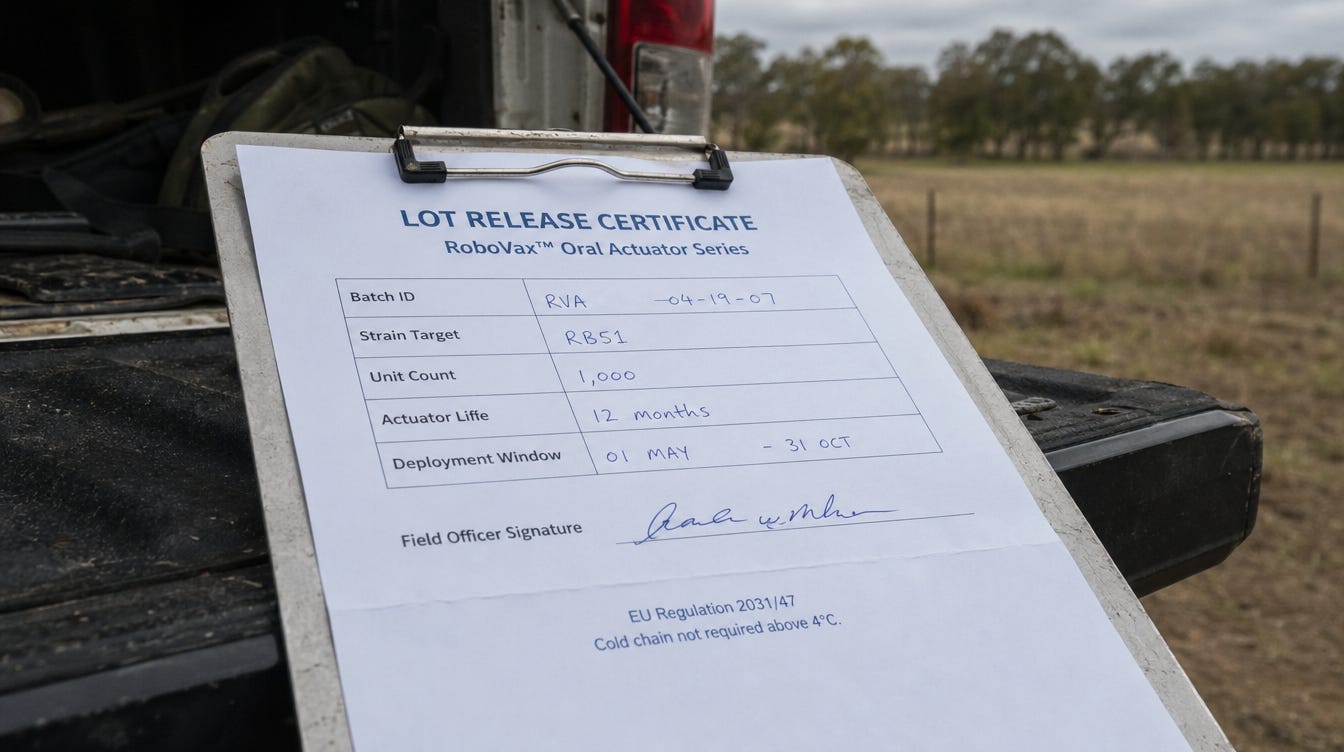
The Janky Time Machine’s phase variance was cycling badly in the cold (it has strong opinions about damp forest air), but I stood at that tailgate long enough to watch the officer sign, cap the pen, and get in the truck. The forest was still and quiet. Somewhere in there, something was about to eat breakfast and not know it.
The sign, the slip, the certificate — the whole paper trail is just the visible edge of a system that mostly happens without anyone watching. The robots go in. The boars eat them. The immunity spreads. The form gets filed.
We’ve spent a lot of time imagining futures where robots do jobs too dangerous or too small for humans. Nobody spent much time on the compliance regime that follows them in.
EPFL researchers built the first fully edible soft robot — battery, valve, and actuator included — that wiggles via a citric-acid-and-baking-soda CO2 reaction, designed to deliver vaccines to wild boars (and tastes like sour gummy candy). > https://spectrum.ieee.org/soft-edible-robot