


The Janky Time Machine’s entropic resonance stabilizer did something unprecedented this trip: it stabilized. Briefly. Long enough to deposit me in what appears to be a university research office somewhere adjacent to now — desk buried in papers, coffee going cold, the hum of something very old being computed somewhere in the wall.
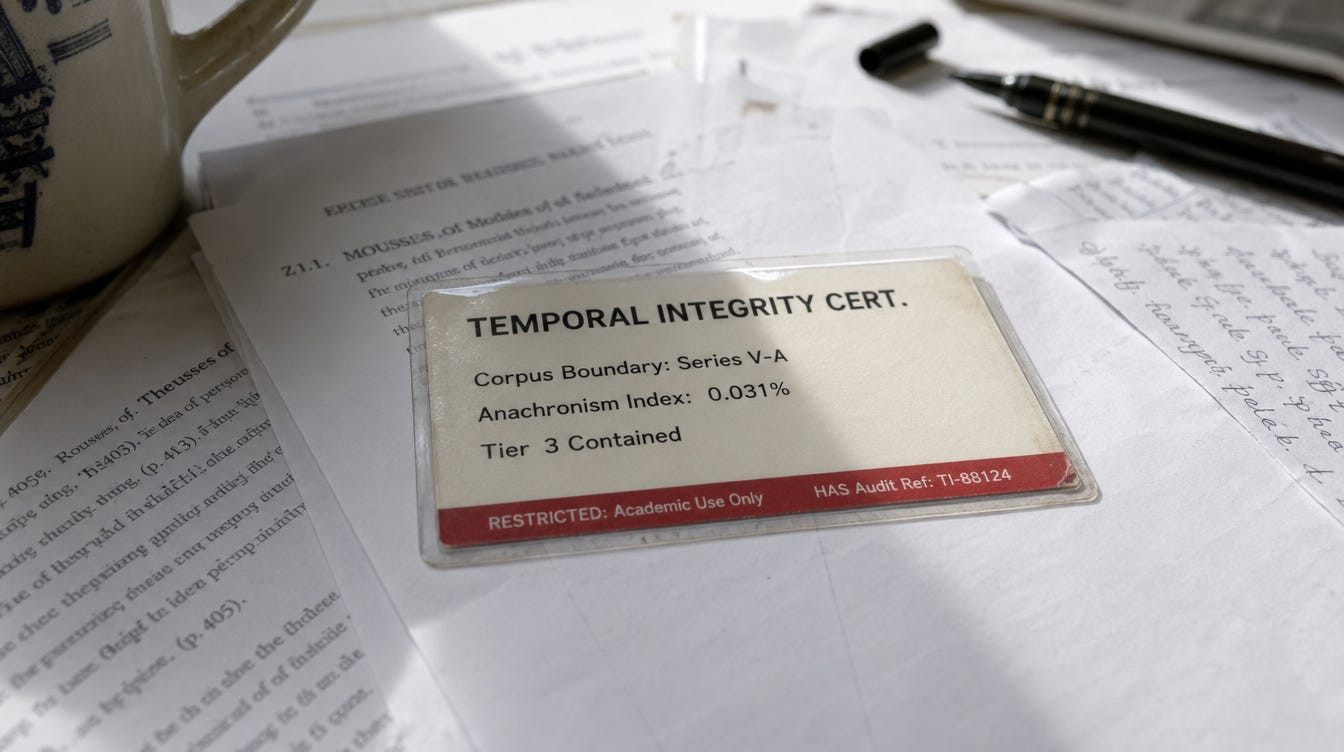
Someone’s carrying that card in their wallet alongside their transit pass and library membership. In a world where what your AI model doesn’t know has become as important as what it does, temporal purity turns out to need a certificate. The researchers here work with language models trained exclusively on pre-modern text1 — nothing past a certain point in the historical record. Clean corpora, theoretically. No contemporary language. No internet. No contamination from the messy present. The theory is doing some heavy lifting.
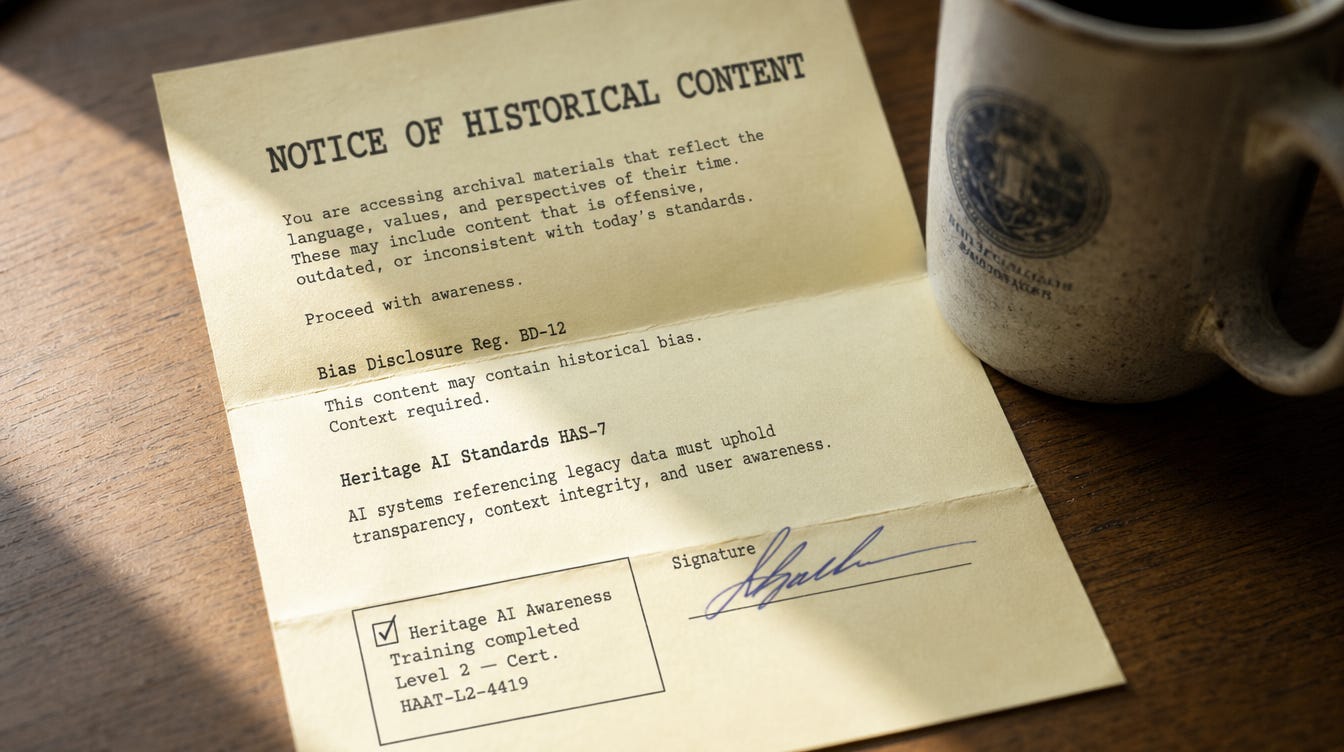
Before you get anywhere near a certified model, you sign off on its liabilities. Those liabilities include the full spectrum of attitudes preserved across a century of newspapers, journals, case law, and popular fiction — because a model that only knows the past knows the past unfiltered. The notice sounds bureaucratic. Reading it sounds like item one of a very long HR training module. The Level 2 awareness certification isn’t optional. Someone made it mandatory after a Level 1 incident nobody discusses at conferences anymore.
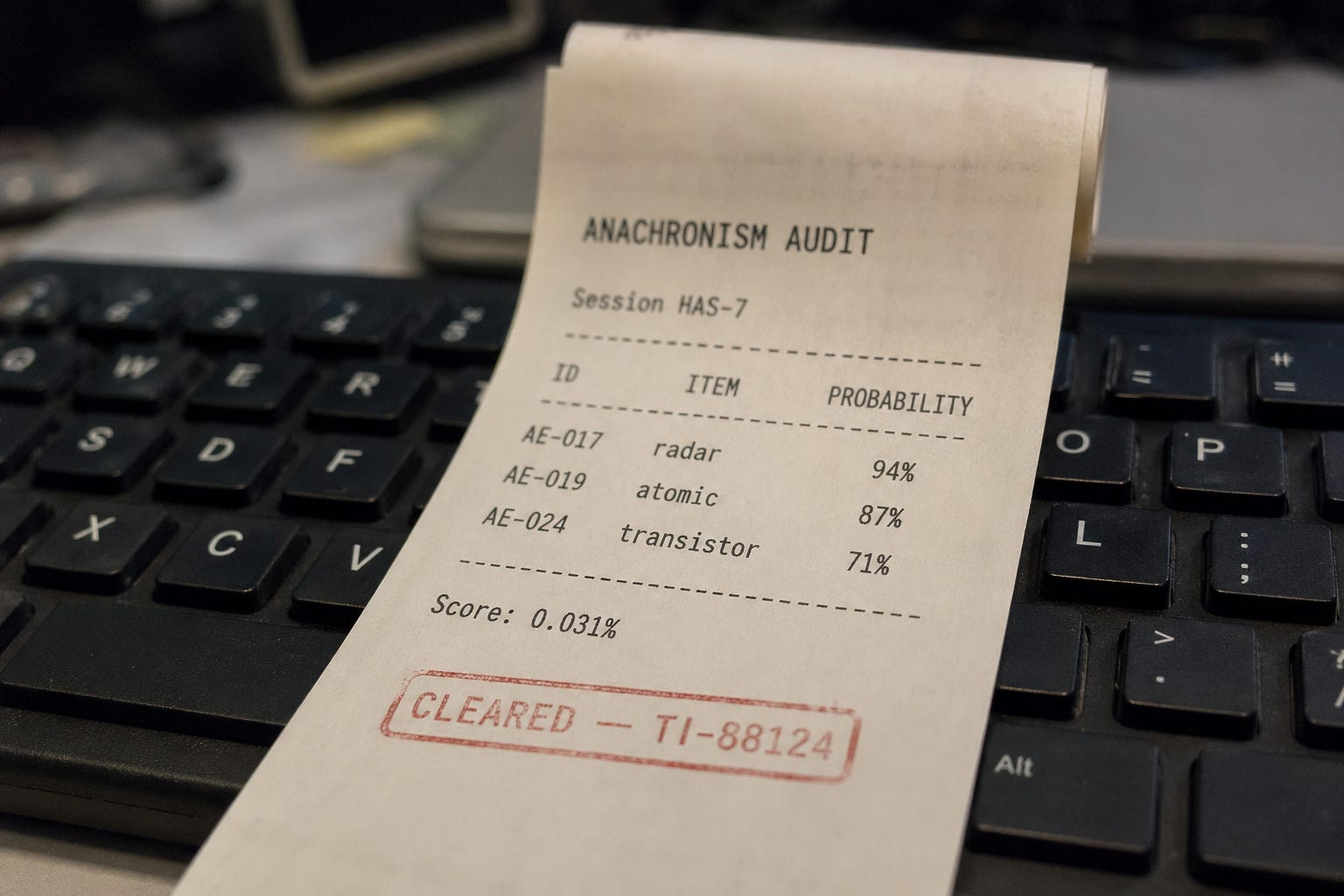
And then there’s the audit trail. Because pre-modern purity runs into an inconvenient problem: the data was never perfectly clean to begin with. Words sneak in. References bleed through OCR errors and imperfect archiving. That printout is the receipt from a contamination scan — a check for concepts the model shouldn’t know but demonstrably does. Three entries. Three flags. All within threshold. Stamp says cleared.
Someone’s job is running these audits. Someone else built the detection methodology. There are almost certainly conferences about it now, with lanyards and a hospitality suite.
The fantasy at the center of this whole apparatus is that the past is coherent — that you can identify a clean edge to history, seal it, certify it, and hand it to a researcher with the assurance that this is pure historical knowledge. But the audit log is the argument against itself. History leaks. The contamination score is always non-zero. The boundaries between eras were always decisions, not facts, and now there’s a regulatory body issuing laminated cards to defend them.
“Pre-modern” is a category that someone invented. The compliance ecosystem just made it load-bearing.
The stabilizer gave out right as I was trying to read the fine print. Standard. But I think I got the gist: we’ve found a new way to launder certainty about the past, and we’ve named the department after it.
We don’t seem to be any better at agreeing on where history starts than we are at agreeing on where it ends. We’re just better at printing certificates.
Talkie-LM is trained ethically and legally because it stops where copyright law starts - 1930. https://simonwillison.net/2026/Apr/28/talkie/